Monday, March 4, 2013

The inefficiency of multitasking

Multitasking has an undeserved reputation as a good thing.

In fact, multitasking simply results in delays, disruptions and inefficiencies.

Does it matter whether you do one after the other (mono-tasking) or you multi-task and do a bit of each one each day?

While things are not usually this simple it is enlightening to see the difference:

Suppose you have three tasks (A, B and C) that each take three days to do (a total of nine days work).
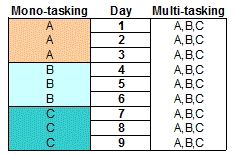

Multitasking will result in all three tasks being finished on the ninth day.

By mono-tasking two of the three tasks get completed sooner!!!

  • A will be finished on the third day - giving six additional days benefit
  • B on the sixth day - giving three additional days benefit
  • C on the ninth day. 
And completing tasks earlier means less chance of disruption and displacement.

In practical terms there are other factors that come into play which may or may not be significant. There are many more changeovers between tasks undertaken with a multitasking approach. Sometimes such changes consume additional time and effort.

On the other hand, one may not have the opportunity to use a full mono-tasking approach. But it is wise to maximise the use of mono-tasking wherever possible.

One way to achieve a higher proportion of mono-tasking is to delay starting some of the tasks. In the above example of mono-tasking  B is not started until Day 4 but is finished at the end of Day 6 - three days earlier than the multi-tasking result.

Worth thinking about, even if it is contrary to common wisdom.

Thursday, February 7, 2013

Leadership and Management


This is a perennial point of discussion. Leadership and management get very confused.

So here is my offering:

Every group needs leadership, but that responsibility doesn't need to be allocated almost exclusively to one person - everyone has a responsibility to contribute to the success of the group (to be a leader) at times. It is simple, and it works!!

Occasionally a situation arises when someone has to make a decision now - that is a job for the manager.

Most of the time a group simply needs to find (often small) ways to make things easier and better - this is where leadership comes in. The leader is the person who can help the group move forward.

Leadership is a relationship with other members of the group - ideally flexible, dynamic, etc.

  • Authority to lead is granted from below by the group.

Management is a role assigned to a person - largely fixed.

  • Authority to manage is delegated from above by the organisation.

Sunday, January 20, 2013

Are systems real?

Maybe not as real as we think. And certainly less real than our everyday conversations generally suggest. Naming something as a system does not make it a system. Nor does it validate the use of system thinking in the situation.

However for various purposes, and under certain conditions, we can proceed 'as if' we are dealing with a system, at least for the time being. The danger lies in assuming that some aspect of a situation can be treated as if it is a system. As Marshall McLuhan said, when we name something we stop thinking about it.

The central idea underpinning systems thinking is that, to a greater or lesser extent, we can rely on the existence of certain patterns of interaction between the elements involved.

In the physical world interactions are shaped by largely universal natural laws, hence the consistency of many interactions is usually very high. Drop a raw egg from a height of two metres onto concrete and the acceleration of the egg and the outcome can be readily predicted - the interactions between the egg and gravity and the subsequent interaction between the egg and concrete are highly consistent for eggs in this situation. Hence, we can address the situation with systems thinking.

Highly consistent patterns can also emerge in human interactions. Not so much because of natural laws but because of shared belief systems, shared goals and agreed practices, social regulations, corrective consequences... Shared beliefs, agreements, regulations, and consequences can act as 'attractors' around which consistent actions and interactions emerge.

Such situations can often be treated 'as if' they are systems, especially if
- the goals/expectations are known and agreed
- inputs are consistent
- processes are clear and practiced
- 'outcomes' are measured and reported against the goals/expectations

Systems thinking can then be applied so that changes and improvements are achieved
- increasing the consistency of the interactions
- changing the interactions to
-> use different (new, less...) inputs
-> reduce variation 'errors'
-> make interactions easier (so that the 'system' is more efficient)
-> improve outcomes (so that the 'system' is more effective)

That is, by continuously monitoring a situation and using informed judgement it may be valid to treat the situation as if it was a system.


Thursday, December 13, 2012

Initial conversations


A good friend is moving to a substantially new role in the coming year. His background is mainly in PR (he is terrific with people) and he is about to become the CEO of a service organisation. His PR capabilities will be invaluable but how will he start to bring things together -  the organisation is in need of some updating and he will need to make sense of the situation asap.

 My recommendation is to start a conversation with staff  that will be ongoing. It could be based on a simple but valid job description
  1. Know what is happening
  2. Work with others to improve what is happening
  3. Make it easier for the next person to do well
Using this framework, my friend will begin with information 1:1 conversations along the lines of
  • How clear are you about what is happening? (And how can we improve that?)
  • How do you work with others to improve what is happening? (Examples? And how can we extend that?)
  • How do/could others make it easier for you to do really well?
  • How do/could you make it easier for others to do really well?
Effective systems as well as individual and team performance rely on the 3 key elements of the job description (above). Improved systems can then emerge easily, naturally and quite quickly from such conversations because they are about real-life actions and solutions. Used continuously they also form a sound basis for integrating continuous improvement into the culture of the organisation.

Sunday, October 28, 2012

The Social Contract

What is the glue that holds all our individual and collective actions especially given the uncertainty of the next person's possible responses in the present context?

Perhaps we proceed on the basis of a social contract to which we believe that we and those with whom we interact are both parties.

Restorative practices restore and strengthen the "social contracts" that underpin our interactions.
Problems arise and harm is done when these social contracts are broken intentionally or inadvertently.

However most social contracts are unconscious - they are just assumed and "understood".
The long term power of restorative practices in general, and circles in particular, is that they can strengthen our social contracts by making them more explicit.

This can also make the wider implications of our actions much clearer before we make our next serious mistakes."

Wednesday, October 17, 2012

Reviewing progress

The world has the idea that if we measure (and report) outcomes all else will follow. One of the flaws in this approach is that it ignores the everyday reality of those charged with achieving the said outcomes. But what is the alternative?

The following is based on a review process that we used almost universally at Riverside Primary School, albeit, at the end of last century. However this significantly post-dates much of the current thinking which tends to be a form of Management By Objectives (circa 1950).

Three simple questions
The proposed alternative it is a form of action learning based around three simple but insightful questions:
  • What's working? 
  • What's not? 
  • What else (might be possible, desirable, feasible, worth a try...)?

Not only is it quick, simple and meaningful, it leads to positive action. It is more likely to lead improvements than counter measures. It is naturally solution focused, rather than problem focused.

And it builds up the social contract around core purposes - the social contract is strengthened when people are consulted, heard, and responded to, and their contributions recognised.

This approach can be used individually and in groups (especially circles) for virtually any purpose.

And (used consistently) it results in continuous improvement (plan-do-study-act) and not simply episodic attempt to fix things. When it becomes part of the culture ("how we do things around here") people continually monitor how things are going gaining insights from their everyday experience./

Monday, September 17, 2012

Rethinking education - some common traps

This morning I came across this
Three essential questions
In discussing our response to new possibilities it can be really helpful to think about what questions we are answering. Clearly Will Richardson and many of the commentators have been answering the question
Q1. What is possible?
But in responding to what is possible we need to be able to answer two more questions:
Q2. What is desirable? And to whom?
Q3. What is feasible? And for whom, given their current constraints such as time, energy, existing policies, practices, expectations...?

So what is possible for some stakeholders (e.g., teachers) may or may not be perceived as desirable and/or feasible by other stakeholders (administrators, government, families...)

Common Traps
Clearly there are some potentially hidden difficulties here including
  • Answering any of the above questions in isolation from the other two questions
  • Being unrealistic - "There is a simple answer to every question and it is usually wrong"
  • being unfair - "Nothing is impossible to those who don't have to do it"
  • Underestimating the disruption involved in taking advantage of what has become possible by focusing exclusively on the future and not how to get there. As Deming would ask "By what method?"
  • ...