Thursday, June 23, 2016

How to fix a broken system

I came across this profound TED Talk this morning. Highly recommended.

It would be easy to dismiss the talk as "Interesting, but of little value to us.. our system is already doing so much better than theirs".

Improvement Process
On the other hand I think it has profound lessons for us, especially how they implemented their improvements 
  1. Be clear about what was really happening here and now*
  2. Establish a specific shared goal
  3. Identify the current issues (constraints) in relation to the goal
  4. Create your own solutions (address the constraints)
  5. Change the system from a hierarchy to a network  
If only we all did the same!!!

Everyone's job
Incidentally the strategy fits nicely with the "job description" that applied to everyone at Riverside: staff, students, parents, visitors...
  • Know what is happening
  • Work with others to improve what is happening
  • Make it easier for the next person to do well
And finally, the Talk, and the above notes are consistent with the application of Complexity Theory. Perhaps without knowing it Seema and her team actually treated their education system as a complex adaptive system rather than as a simple linear (top-down) system.

[* Not trying to work back from some remote idealised future "reality"]

Wednesday, June 22, 2016

Education - a complex endeavour

This is the third in a series on systems approaches to education.

Complex adaptive systems
Education is best understood as a complex adaptive system: schools, teaching and learning are all
  • emergent
  • non-linear (Law of Tanobway applies: "There ain't no one best way!!")
  • self organising
  • co-evolving with their environments
  • nested within other systems
As a result it is not possible to accurately predict the outcomes, especially in the longer term. This is true for all complex systems (e.g., the weather). Nor is it easy to replicate outcomes because "best practices" are situated and not readily transferred. 

In complex systems (such as education) knowledge, actions (practices) and arrangements have be continually constructed and reconstructed.

Teaching is largely about discovering and applying what is helpful to the students as they endeavour to learn. That is, teaching is more about the provision of scaffolding that nurtures the emergence of learning. And this works best when teachers and learners work together to customise the student's learning. Notions of "R&D"  are more useful than notions of education as "production". Schools work better as purposeful communities than as "factories".

Improving education
Top-down initiatives can work well in linear systems. However, improving complex adaptive systems such as education is best done by nurturing the emergence of desirable developments. This can be done by
  • introducing attractors (activities, purposes, tools, opportunities...)
  • enabling people to be self organising 
  • basing action and interaction on a small number of simple rules
  • learning from small safe-fail experiments - efforts that will not do any significant damage if they fail. 
Learning from success
Learning from successful experiments needs to be done cautiously.  To conclude from a successful experiment that the method can be widely applied is to make the error of retrospective coherence. Being able to give an account of why/how something was achieved does not mean that it can be readily replicated. 

Complex adaptive systems are subject to the starting conditions. In education these including history, culture, environment... Engineering best practices can be readily transferred - with natural physical phenomena cause and effect are consistent over place and time. The same cannot be said for teaching and learning - cause and effect are not universally consistent and may be distant from each other in place and time.

Evidence-based practices
Unfortunately many top-down initiatives are based on mandating the use of evidence-based practices, as if they work like engineering practices. The notion of "evidence-based practices" is usually flawed by retrospective coherence, and frequently leads to the injustice of "They did it, why can't you?"  Education has a history strewn with examples of initiatives that failed despite their origins being based on prior successful examples.

Tuesday, June 21, 2016

Schools and systems thinking

As a follow up on yesterday's post it may be helpful to clarify two major notions of systems.

1. Linear systems:   input=>process=>output
The most common notion of a system is one in which input is processed to create an output.
These  systems are often described as linear and can be as simple as a light circuit:
- the input of electricity flowing through the circuit causes the globe to output light. The process  may involve  the heating of a filament the activation of some other source of light.  
Combining such systems, and building in feedback loops, can create quite complicated devices such as airliners, computers etc.  In linear systems, cause and effect are consistent over place and time such that outputs can be replicated. That is, outputs are predictable.

2. Complex adaptive systems: emergent, self organising...
Complex adaptive systems are the second major type of system. The outputs emerge from the interaction of the elements within the system and the interaction of the system with its environment. While patterns may emerge overtime outputs cannot be predicted accurately, especially over the long term.  Weather,  social systems and ecosystems are common examples of complex adaptive systems.


As social entities, schools are complex adaptive systems. However they can often be treated,  at least in part,  AS IF, they were linear systems. To do so is reasonable under certain conditions, namely that the patterns of interaction involved a stable.  Hence Deming's advice to  “first stabilize the system”  before trying to improve it.


Complex adaptive systems are vulnerable to disruption but may also be highly resilient as a result of their capacity to be self organising and their wide range of possible responses.  (see Requisite Variety).

Systems thinking and its limitations
Systems thinking as it applies to linear systems, offers a range of very useful approaches and tools for school improvement.  However it  is critical to understand the limitations of systems thinking and the assumptions made being in its application to specific circumstances.

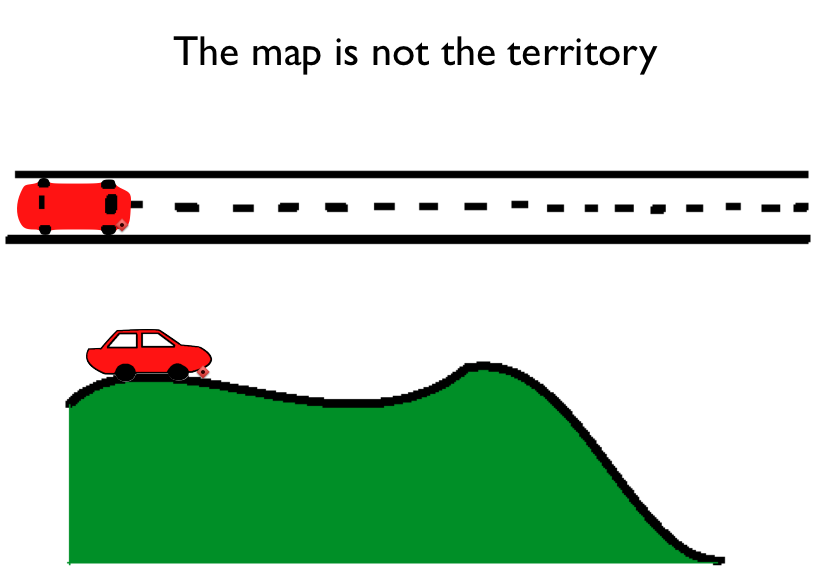
A systems models is a kind of map of the system and it is important to remember that "A map is not the territory".


Monday, June 20, 2016

Schooling - symptoms and causes


Creating a linear view

When faced with something challenging and complex, our natural inclination is to treat it as if it was linear. And under certain conditions this can be useful. The danger is that we may begin to confuse our "linear models" reality. 

Schooling is a complex endeavour - one that is often complicated and uncertain, especially in relation to the processes, participants and the contexts in which it occurs.

 Consider the following simple linear model of schooling:

The model is a reasonable summary of the commonly held view of how the school system works. Because of its general nature the model "works" despite the variations that that may apply. For example, government policy and funding varies considerably from school to school and government to government.

Cause and effect
In terms of time and activity the general flow of cause and effect is from left to right. Since most students are children they tend to have little or no responsibility for the effectiveness of the system. This "justifies" the widespread use of of student achievement (effect = learning outcomes) as an measure of school performance as cause.
Also cause and effect can be remote in both time and place - a cause may not be directly related to a effect (see 5 Whys). For example, the model does not indicate the extent to which government policies and funding enable/constrain the capacity of schools to provide teaching matched to the needs of their students in real-time.

Too simplistic
The model is too simplistic in that it does not show any feedback loops nor does it give any indication of strength of flows between its elements. 

Nor does the model show all key participants many of which play an important role in the effectiveness or otherwise of the system.

A useful starting point
The model is quite inadequate to properly explain how schooling happen. On the other hand it does represent the general discourse quite well and hence could be provide a useful starting point for the development of a systems approach to school improvement. And a systems approach is needed to better inform decision making at all levels.
Caveat:  "All models are wrong but some are useful (George Box)"

Monday, May 23, 2016

Gonski and beyond

Gonski may have a more important modelling role to play in improving the education of all Australian students. Extending the Gonski approach to all schooling could save our schools from current well intentioned but poor top-down decision making.

Money is vital, but methods translates money into value. And the Gonski "method" is soundly based for education.

The current general discourse about schools goes something like
  
More $ for Education
      -->  "Better" teachers, testing/reporting, required curriculum, mandated practices....
         -->  Better student Outcomes

This is plausible from a management or production perspective, but it does not reflect any known education theory.

Schools are not factories!! Education is not a form of production. Students are not products.

In addition this common top-down approach does not result in the requisite variety of educational provision needed to meet the needs of all students. 

The value of Gonski

In contrast, Gonski encourages and supports the development of whatever provision will meet the needs of specific students.

Some useful theory

Education is a complex endeavour. Schools are best understood as complex adaptive systemsTo work with and improve complex adaptive systems we need appropriate theory. 
  • People in schools (and elsewhere) are self organising around what attracts their attention
  • Schools are situated and emerge from the interactions of those involved - students, staff, families, communities, departments, governments...
  • Schools co-evolve with their environments (communities, school system....)
  • Successful practices are not as readily transferable as one might assume - they have to be reconstructed 
The necessary knowledge, actions, and arrangements involved in schools have to be continually constructed (and re-constructed) by those involved, mostly in everyday conversations. Practices from elsewhere have to be reconstructed anew in each school.

This means that schools not subject to empirical research in an engineering sense.
  • Input --> Process --> Output is not a useful working model for whole school improvement
A constructivist perspective (Vygotsky)
  • Zone of proximal development
    • Learning expands/extends what a person can know and do
    • At any point in time there is a potential "zone" of learning beyond what person can know and do with "assistance"
    • This developmental zone is specific to each person in place and time
    • At any point in time, it is not feasible for a person to learn beyond their zone of proximal development
  • Scaffolding
    • Provision to support learning ("scaffolding") needs to be matched to the learner's zone of proximal development in place and time (Gonski)
    • Teaching is largely about scaffolding learning
    • Better scaffolding is likley to improve and extend learning
    • Scaffolding can be
      • Cognitive - instruction, direction, coaching and tuition...
      • Physical - texts, tools and equipment, facilities...
      • Chronological - timing, sequencing...
      • Social and emotional - encouragement, motivation, confidence...


Leadership is situational (Blanchard)
  1. Education involves substantial leadership
  2. Leadership is a combination of direction, coaching, support and delegation 
  3. The appropriate leadership style depends on the learner's Competence and Confidence / Motivation in  relation to the learning task to be addressed in the current context

Gonski - a model for the future of schools

Gonski (consciously or otherwise) is consistent with a constructivist approach​ and encourages situated leadership. The initiatives supported by Gonski are situated and emergent.

If the Gonski approach can be extended to all schooling, it will improve learning outcomes of all students and reduce the need for Gonski as an add-on.

Caveat: For this extension to occur it will be necessary for governments and senior bureaucrats to recognise that 
  • While they may be in charge they are not in control
  • Education is a complex endeavour
  • Engineering solutions do not apply to the key challenges involved in providing quality schooling for all

Tuesday, January 6, 2015

People are self-organising

If you look at the world's leading, most effective, most resilient "organisations" (Google, Apple, MSF...), one of the things they have in common is that they enable their people (both staff and clients) to be self organising.

Their organisational structures, policies, processes enable the people involved to be self-organising around significant goals ("attractors").

The opportunity to be self-organising is a fundamental human need. Many societies punish offenders by reducing their capacity to be self-organising - offenders are put in gaol, denied the right to drive, fined, grounded, lose their mobile phone for a week... When people are constrained from being self organising in one area they tend to find new ways to meet this need.

Some of the quickest, cheapest ways to improve any organisation (and do more with less):
  • Make the goals more attractive to those involved and
  • Expand the opportunities for collaboration (negotiated self-organisation)
This works because it takes less effort to do "what we want to do" than "what we have to do".

Unfortunately many of the dominant management ideas that counter the above
  • We need managed organisations because people can't/won't organise themselves (why not?)
  • We need to safeguard against people making ill-informed choices (but remote managers continually assume they make better choices?)
  • Leaders need to be in control (but in reality, they are only in charge at best)
  • Compliance is more important than contributing (but people need to contribute)
The above ideas are not new: “A leader is best when people barely know he exists, when his work is done, his aim fulfilled, they will say: we did it ourselves.” (Lao Tzu 600 - 531 BC)

Sunday, February 9, 2014

Restorative practices - an intelligent approach

We act intelligently when we improve/increase our future options and address the bottlenecks (constraints) that we encounter along the way. On this basis, restorative approaches are likely to be more intelligent than the common punitive approaches used in many schools. 

Suspensions, expulsions, zero-tolerance... may reduce local difficulties in the short term but they rarely represent an intelligent response - problems are not really resolved and are likely to recur and to be extended albeit to other places and other times. 

Quite often, the natural consequences of a punitive approach far exceed the formal consequences imposed by the punitive system: suspensions become pushouts become an uncompleted education, long term unemployment, poverty... and so on.  Yet schools are supposed to be places that nurture intelligence.

Punitive approaches tend take away options from wrong-doers (and from those who have to respond) by placing ongoing constraints on their current and future options. A suspended or expelled student may have few genuine opportunities to learn from their own actions, and to repair the harm they have done. 

Punitive policies, such as "three strikes and you are out...", also reduce the capacity of school staff to explore options that will result in a better future for all. That is, such policies even reduce the capacity of staff to act intelligently. 

Using punitive approaches the initial harm is rarely repaired and on-going costs are likely to increase. Victims may acquire long lasting bottlenecks (e.g, anxiety...) that are very costly, greatly extend the initial unresolved harm and reduce future options.  Without help to repair the harm they have experienced, a seriously bullied student may become a school-refuser and/or do harm to themselves and/or others, all of which reduce the student's future options and life chances. For more, see Compass of Shame.

Using a restorative approach, a wrong-doer is challenged and supported (Social Discipline Window) to 
  • gain insights into what happened and the thinking involved
  • gain insights into the harm that has been done, and to whom
  • take steps to repair the harm that has been done (if at all possible) and
  • remain in school as a civil and productive student within the school and its community
Clearly, using this approach, the 'offender' has a brighter future (more options and fewer bottlenecks) despite the seriousness of their initial actions.

And a student whose harm has been properly addressed in a restorative way is less likely to experience the shame of being a victim and is thus more likely to have an unimpaired future.

Of the two approaches, being restorative is clearly much more intelligent than being punitive.

[Note: The above thoughts were prompted by the TED Talk by  Alex Wissner-Gross: A new equation for intelligence. The talk may not be all that easy to follow at times.  However, its value was that it reminded me about the signs of intelligence]