Monday, March 6, 2017

Responding to problems

"Problems" are everywhere
Things could always be better. The world is not always how we would like it to be. It could be fairer, more efficient, more effective, cheaper, nicer, easier, more ethical...

Sometimes problems come and go like the weather. They may dissipate of their own accord. Or they may grow bigger and more serious and need to be addressed in three ways
  • Contain the problematic situation
  • Repair any harm done 
  • Reduce the likelihood of the problem recurring
The challenges of responding
Quite often we need to work with others to solve problems, and this brings its own challenges. How others see the problem and what level of response they are trying to contribute can make a big difference. Consider the following

The "Ostrich"
  • Unaware of the problem
  • Deny the existence of the problem
  • Hope it is someone's problem
  • Hope someone else will fix it
The "Expert"
  • Describe the problem with examples and anecdotes
  • Guess the causes and solutions
"Ain't it Awful"
  • Complain, Blame and Protest
  • Demand the problem be fixed 
  • Demand a particular "fix" -  can make things worse
"Bob the Builder"    
  • Understand how the system works to create the problem
  • Work with others to ("fix")  improve the system
Check it out
  1. Think of problem that is significant to you
  2. What is your current level of response?
  3. What difference will your response make?
  4. How does this compare this with the responses of others involved?

Sunday, February 12, 2017

Thinking about schooling

Direct, unfiltered experience of the universe is overwhelming so we need to filter and reduce our experience to something simpler than its reality. Education is no exception.

How we think about something shapes our understanding of it and our approach to dealing with it. Metaphors can be useful in encapsulating a wide range of ideas, arrangements and activities in a few words. They can make it easier to cope with large scale experiences and to share complex ideas.

At the same time, there are several dangers involved in this approach, including
  • much of our thinking based metaphors is unconscious and erroneous
  • we tend to disregard or overlook the aspects of reality that don't fit our chosen metaphor/paradigm
  • we tend to believe aspects of our metaphor/paradigm are valid, even though in reality they are not

Schooling as "engineering" is not a useful metaphor

Engineering is based on the natural laws that apply to phenomena in which cause and effect are consistent over time, place and object. Unfortunately, no such natural laws can be applied to schooling. In education, cause and effect are not consistent over time, place and person. People are not objects in an engineering sense. 

Schooling as "medicine" is not a useful metaphor

There is a sense in which some aspects of schooling can be thought of as "treatments". However, we do not "hospitalise and treat" whole groups of people uniformly on a daily basis simply based on their age.

The hope for "linearity"

Things are much easier to deal with if they can be dealt with as if they are closed linear systems. 
  • Input => Process => Output
The natural laws on which engineering is based enable us to deal with most physical phenomena as linear systems. In addition, best practices can be readily established, readily duplicated, transferred and scaled.

To a lesser extent, medicine can adopt a similar approach, using surgery, antibiotics and other therapies at the individual level dependent on the starting conditions (the health and well-being of the individual).

Transferring and scaling practices

Education is more like medicine than engineering because the starting conditions (hopes, needs, abilities.. of the student/patient.) are unique to the individual learner, and successful practices can be duplicated and transferred from one situation to other closely matching situations. 

This is not an indication that we can adopt a linear systems approach to schooling. In retrospect, we may be able to identify the steps that led to successful learning by a student but this is not the same as identifying the steps that will lead to successful learning for all students. 

Educational practices do not transfer or scale anywhere near as well as engineering practices.  "Evidence-based practices" are practices that, on the available evidence, have wide, but not universal usefulness if used in the right context in a timely manner. There are no silver bullets!! 

Mandating certain practices is an overly optimistic approach and disruptive.  Mandated practices will be a service to some students, a disservice to others and compromise the professional judgement of teachers. 

Schooling as its own metaphor

Engineering and medicine are their own metaphors. But what about schooling? Historically schools were developed to prepare young people for working in the industrial age. Are schools factories? Most retain many of characteristic of factories.

Does the required attendance of students give schools some of the characteristics of prisons? Governments remove children from the care of their families on a daily basis in order to attend school.

Interventions in schooling

School improvement is often successful but not long lived. Many improvements are dissipated by the next external intervention or change of school leadership. This is because the school is continually constructed and reconstructed in the everyday conversations of those involved.

The represents a wicked problem for governments because their interventions are based on a linear systems view that supports their belief that the required responses to the interventions are readily transferable and scale. But successful educational pratices are complex (emergent, involve self-organisation, situated...) and so do not scale in the way governments hope.

That is,
  • Education is complex, not linear
  • Its processes are individual, situated and emergent so do not transfer easily nor scale
  • Mandated school improvements are disruptive and not a good fit for most schools
  • Successful school improvement initiatives are generally short-lived - they are disrupted by the next initiative


Monday, February 6, 2017

Australia's Two Speed School System

Structural inequalities in schooling

There are several structural inequalities impacting Australian schools. 

Unfortunately the issue of funding tends to dominate the discussion. Focused on in isolation, this tends to polarise schools into groups such as state and non-state. 

This will intensify as we approach the possible end of Gonski funding and awareness that the difference in government funding for state and non-state schools is diminishing and could well be reversed in the next few years.

Structural inequality begins at enrolment

In terms of enrolment there are two types of schools and they treat both parents and students very differently thus generating and compounding Australia's Two Speed School System.
  • Selective schools can choose whether to enrol (or exclude) any student with little, or no, justification required. Enrolment is a school choice
  • Non-selective schools can only reject an application for enrolment under exceptional circumstances. Enrolment is a parent choice (unless there is some over-riding policy such as zoning)
Before non-state schools received substantial government funding this was not really an issue. Enrolment in a selective school was a commercial arrangement between the parent and the school. 

The early justifications for government funding of non-state schools were that 
  • the parents at the schools were taxpayers and their children should benefit
  • supporting non-state schools was a cost saving strategy for government
As the difference has diminished these claims need to be reviewed. Most of the parents of children refused enrolment by a school are also tax payers and their children should also benefit. Should that be the school's choice?

Government cost savings decrease as the school funding gap between schools diminishes. If a school uses selective enrolments to grow the school the costs to government can increase markedly to provide the additional facilities required.

Now that all schools receive substantial government funding there is a need for terms and conditions around
  • Parent choice 
  • Mutual obligation between government and schools
  • Common benchmarks for rejecting an enrolment application
  • Gaming the system
  • Means and needs testing of schools
  • Double dipping
  • "Leaners and Lifters"

Enrolment and making provision for students

Selective schools enrol students who match the school's provision and community.

Non-selective schools enrol the majority of students whose parents apply and make the best provision they can given the demands they face and their capacity.


School improvement models - better schools start with fewer problems?


Non-selective schools

Selective Schools


Friday, December 9, 2016

Gaming the school system

Two ways to improve school performance

MySchool is the major source of information on "school performance" in Australia.

The fastest, cheapest and easiest way to improve any school is to have more high-performing  students with low needs, and fewer low-performing, high-needs students.

The professional alternative is to improve the school's teaching, curriculum, facilities,... in order to improve the performance and reduce the needs of existing students. This latter approach is much more expensive, slower and is limited by the potential and circumstances of the existing students, engagement of families, aspirations...

Why take the easy option?

It makes sense for the schools that can choose their students to take the first option because of its speed, economy (little or no cost), simplicity, and effectiveness.

But there are additional reasons too.
  1. All schools want to be "good" schools
  2. School are under pressure to approve in MySchool (and similar) rankings
  3. Other schools are doing it
  4. It will be good for the students we select
  5. There is a long history of the practice
  6. It will enhance the school's "performance" and image
  7. The school will have fewer problems, challenges, and incidents
  8. The school will have a stronger focus on learning and achievement 
  9. Existing students are likely to benefit
  10. Parents want their children to go to a "good" (successful) school
  11. Parents want their children to have "good" classmates
  12. Parents want to associate with the right class of parents
  13. Principals want to be able to attract and select the right class of staff
  14. Being a staff member at a "good" school can help one's career
  15. ...

Parents do it too !!

It is not unusual for parents to give grandma's address are the home address in order to overcome a zoning restriction that would prevent their child being enrolled in their preferred state school.

Similarly, parents may profess a religious belief that they don't hold in order to achieve enrolment for their child in their preferred non-state school. This probably works better as a two-player game where the school does not actually practice its claimed religious beliefs. For example, the school may not "Suffer the little children to come..." resulting in some other school having to suffer the children they have rejected.

Colateral damage

Unfortunately, this approach results in some collateral damage. Schools that use this approach are, in effect, increasing the demands and challenges faced by the schools that enrol the "ones they reject" (John West style). 

At a system level, this means that advantage and disadvantage are being concentrated in different schools. This outcome can be easily explained away because the total number of schools means that there is an advantaged-disadvantaged spectrum of schools and disadvantage can be explained away by other contributing factors such as aspiration, poverty, levels of education in the community...

However, the collateral damage is not much of a problem for the school doing the rejecting because it tends to occur at times of transition; the rejected students are dispersed across numerous schools, and families who are rejected are unlikely to make an issue of it so that avoid any associated embarrassment.

To help in this process schools can also provide positive face-saving explanations for declining an enrolment application, such as "Unfortunately the year group is full" or 
(sadly) "We think your son would be much better off at school X.  It has a wonderful record of dealing with needs like his".

Gaming the system

Gaming occurs when one party uses what is permitted in a system to achieve an unfair advantage over others, or at a cost to others, in the system. 

Some schools are permitted to select their students. Other schools are not permitted or not able. 

A school that use their ability to select students to avoid the responsibility and cost of educating a student and thus pass it on to another are gaming the system. This is especially true when the strategy enhances the image of the rejecting school and makes it more difficult for the receiving school to gain recognition for what it achieves.

This phenomenon is the major contributing factor to Australia's Two Speed School System.  The fact it is widely entrenched in all sectors of the school system will make it very difficult address. Failure to do so is likely to further increase the cost of schooling and the continual decline of student outcomes.


Wednesday, December 7, 2016

It is the system!!

The way Australia's school system works is the problem!!


Most claims about the problem with Australia's school system are wrong, at least in part. The fundamental problem is not "poor performing" schools, funding, the quality of teachers, curriculum, lack of aspiration...  It is the way the system works.

Similar per capita funding for all schools together with different rules for different schools is driving our school system backwards while increasing costs and producing poorer outcomes.

The present Australian system works like this...
  1. Government funding for schools increases each year
  2. Increases and indexation favour non-state schools (1) resulting in
  3. Per capita govt funding is now similar for all schools (2) which means
  4. Per capita govt funding is similar for state and non-state schools (3) but...
  5. Some schools select which students to enrol - no mutual obligation for government funding received
  6. Advantaged schools attract students, eg, reputation, scholarships... (2, 3, 4)
  7. Some schools select capable, low needs (low cost) students (5,6)
  8. Advantage becomes more concentrated particularly in non-state schools (7)
  9. Students in advantaged schools do well - teachers have a small range of needs to meet  (8)
  10. Higher SES schools "out-perform" lower SES schools (9)
  11. Non-state schools "out-perform" state schools (9, 10)
  12. Disadvantage becomes more concentrated in lower SES (state) schools (5 -11)
  13. Students in disadvantaged schools do worse - teachers to meet have a wider range of needs (12) 
  14. Overall outcomes decline (9 - 13)
  15. Costs continue to increase as a result of indexation
  16. Demands for additional funding for disadvantage increase, eg, Gonski (12 - 14)
  17. Costs rise to "fix" the system and improve outcomes (12 -16)
  18.  Go to 1. above
Conclusions
  • The system separates and entrenches advantage and disadvantage
  • The system is undermining itself by generating "two speeds" of schooling
  • The cost of the system will continue to rise
  • Results will continue to decline
  • Effective counter-measures (interventions) will become un-affordable
    How to fix the system
        Change the rules* connecting government funding and student enrolment so that schools can no longer advantage themselves at the expense of other schools.

    *  See Australia's Two Speed School System

    Tuesday, December 6, 2016

    Schools and frogs

    Why "Schools and frogs"?

     If you place a frog in cool water it will probably sit there. If you place a frog in hot water it will jump out. The metaphor of the boiled frog suggests that if you heat the cool water very slowly the frog will sit there until it is dead.

    Until recently, I had always thought government per capita funding for non-state schools was only a fraction of per capita government funding for state schools.

    So I was shocked recently to discover that per capita government funding for non-state schools is now very similar to the funding for state schools. And because of different indexation rates for the school sectors,  non-state schools will soon be getting more government funding than state schools. (more...)

    How did this happen?

    Like the temperature of the water in the pot, total  per capita government funding for non-state schools has been slowly increasing over the last few decades.

    The increases have been masked by numerous factors
    • numerous changes over a long period of time have all been small, well-intentioned good ideas ("slowly warming the water")
    • government funding for schools is reported in terms of percentages or total amounts per sector rather than per capita making comparisons difficult
    • historically, non-state schools have always received significantly less total and per capita government funding
    • both state and federal governments are involved in school funding and report separately
    • annual increases in funding have been small ("slowly warming the water")
    • historically, some non-state schools have been in urgent need of support, especially small catholic schools
    • having students attend non-state schools was a saving to government (but this is no longer the case)
    • the rationale that all students are entitled to the educational benefits of taxes paid by their parents
    • no-one within the system has been monitoring the cumulative changes to the way the system works (or doesn't work)
    • ... and so on

    What happens at the tipping point?

    We have now reached the tipping point. Per capita government funding for all schools is now similar and different indexation rates mean that, from now on, most non-state schools will receive more per capita government funding than state-schools. Who could ever have imagined such a thing?

    This will further
    Ultimately, it could mean the decline and death of many state-schools and an unaffordable school system. World-wide there is interest in privatising schools as if they can be managed using a market approach. 

    So is this another market-based solution?

    Genuine market solutions are based on client choice and should result in falling prices and improved quality, but none of these apply in Australia's system of schooling.

    Students have no choice. By law they are required to attend a school and the school is chosen by others.

    Parent choice is very limited.  Government zoning policies usually mean that many parents can choose any state-school they like, provided it is the local one (remember the Model T?). 

    The idea that parents can choose a non-state school for their children is largely an illusion. Parents can apply but the choice to enrol a student belongs exclusively to the school. In fact, this is often entrenched in legislation.

    The cost of schooling to both parents and government is increasing rapidly

    Price of schooling  = cost to parents (fees, on-costs) + cost to government
    • The cost to parents is considerably higher in non-state schools while the cost to government is now similar. There are no offsets involved except some tax deductions for parents which is an additional cost to government
    • The movement of students to non-state schools results in increased enrolments which incurs the cost of additional facilities often involving increased costs to both parents and government
    Quality is not improving. Educational outcomes have flat-lined and rankings are dropping. 

    Unlike Finland and Singapore, Australia's two speed schooling is increasing the concentrations of advantage and disadvantage. The net result is poorer overall outcomes.  At state and national levels the "top" performance of the advantaged cannot compensate for the "poor" performance of the disadvantaged. 

    Will the frogs respond?

    The impact of funding arrangements for Australia's schools has heated up and getting hotter.

    Key questions:

    • Are the  decision makers aware of what is happening? And why? (see It is the system!!)
    • Will they "jump out of the present arrangements" and find ways to resource Australia's schools for better outcomes? 

    Monday, December 5, 2016

    Australia's school vouchers

    Q: Does Australia have school vouchers?

    YES  !!

    The current school funding arrangements are in effect a hidden voucher system. Most schools receive similar per capita government funding for each enrolled student. By enrolling a student the school attracts the funding. The student is his or her own voucher.

    Q: Can these vouchers be used at any school?

    Maybe.  Conditions apply!!

    For most state school students the vouchers are only accepted by local schools because of zoning policies. Coincidentally this also drives up real estate values in areas with "good state schools" - check out real estate advertising.
    Typically vouchers will be accepted by catholic and "independent" schools provided that student performs satisfactorily, has low needs and is, with his or her family, socially acceptable.

    Q: Do school vouchers allow parents to choose schools?

    NOT REALLY !!

    Parents can choose the local state school (not really a choice) or ask a non-state school to enrol their child. 

    In the latter situation it is the school that chooses. And these school generally prefer high performing, low needs (low cost) students from families with considerable material and social capital. 

    What this means is that there is significant inequality in the ability use the voucher system. And that that it favours more successful students and affluent families.

    Scholarships and vouchers

    In some ways a scholarship is like a voucher - it appears someone else is paying for the cost of tuition. But in Australia's schools they already are!! Levels of government are similar in most schools. See Unlevel Playing Field (Bonnor and Shepherd)

    Q: Who pays for scholarships?

    Governments, Parents  and other schools!!

    In most instances scholarships are quite already funded by the government. That is, the  level of government funding received by the school offering the scholarship covers the actual cost of having the student in the school. The school gets the credit, the government meets the cost.

    Most scholarships are offered by non-state schools and they are usually about increasing enrolments and enhancing the image of the school.

    Non-state schools frequently offer "half-scholarships" in which the family pays a part of the school fees. This is likely to result in the school making a useful profit on the scholarships it is has "given". 

    But it is not only the government and parents who pay for scholarships. When high performing, low cost state school students move to non-state schools it disadvantages state schools they leave by increasing the concentration of need and disadvantage, and by decreasing social capital available to the school and its community.

    Saturday, November 12, 2016

    The two speed sport of schooling

    The Aims of Schooling

    To maximise the performance of each player, in order to
       (a) increase the success and well-being of each player
       (b) increase the success of the nation

    The Rules of Schooling

    1. Everyone at certain ages is required to join a club and play the sport regularly

    2. All clubs play in a single competition

    3. All clubs ensure all their players take part in the competition

    4. Clubs are ranked on player performance using each player's "fantasy team" points (aka NAPLAN results)

    5. Club rankings are published regularly on the MyClub website and analysed in the media

    6. Using public funds, the governing body is equalising its grants to all clubs

    7. There are two types of club which play under different rules imposed by the governing body

    Type A clubs: Participate in the Draft and no Salary Cap
    • Select their players from those who apply for membership
    • Can decline any membership application without explanation
    • Can provide incentives to attract the high performing players 
    • Have good-to-excellent training facilities, transport, coaching and support staff...
    • Can de-list players who are injured or under performing
    • Set their own fees for player memberships
    • Can charge for added services
    • May require players to provide much their own equipment...
    • Can list players from anywhere, including imports
    Type B clubs: Excluded from the Draft and fixed Salary Cap
    • Must list all players who apply for membership regardless of their condition, ability, interest, ...
    • Can only decline to list a player under exceptional circumstances
    • May or may not have adequate facilities, transport, coaching and support staff...
    • Are only able to de-list players under extreme circumstances
    • [Can only list players from the surrounding area]

    Questions:  

    1. What other sports use "one competition - two sets of rules"? (7. above)
    2. Is the governing body making proper use of public funds? (6.)
    3. Is the governing body improving the sport or some clubs?
    4. How well is the sport achieving its aims?
    5. What changes to the rules would improve the sport?
    More background information on Australia's Two Speed Schooling System

    Wednesday, October 26, 2016

    Understanding variation

    Managing schools is unnecessarily complex
    Increasingly schools are expected to be all things to all people. And this involves being able to deal with serious major challenges, many of which have their source well outside of the school and are beyond the capacity of the school to (re)solve.

    If there was a sound understanding of variation in schools, governments, school systems and schools may well make much better responses to the challenges involved.

    Sources of variation (Deming)
    In any system there is always variation
    • some from the system itself ("common cause")
    • some from outside the system ("special cause")
    • some variation is easily managed and/or tolerable
    • other variation is problematic (often described as "a problem")
    A well developed stable system (e.g., a well managed school with the right students) has minimal common cause variation and manages the variation it creates easily and well usually through continuous improvement.

    The level of 
    variation produced in a system increases during periods of change. Therefore it is better to improve the system than to change it (if possible). Continuous change just tends to make things worse over time.

    The impact of special cause variation 
    Variation from outside the system is likely to be unpredictable and beyond the capacity of the system to immediately manage and resolve: special responses are needed.

    In reality much of the work in many schools deals with special cause variations. Examples include the flow-on effects of disabilities, family breakdown, domestic violence, neglect, mental illness, economic downturns, poverty, crime, abuse and trauma, drug and alcohol issues... none of which are produced by the School. 

    With few exceptions most special cause variation impacts negatively on standard measures of student performance. Responding to these negative impacts means
    • containing problematic situations
    • repairing the harm done (as much as possible)
    • reducing the likelihood of the problem recurring
    This list is a fairly accurate description of much of what many schools and their staff members actually do on a day to day basis, often in quite innovative and heroic ways. 

    Student selection and "school performance"
    Some schools are able minimise special cause variation by attracting and selecting students who bring with them minimal special cause variation. Students whose exceptional performance can be highlighted to reflect positively on the school are also likely to be attracted with scholarships and selected. Many individual musical performances at Speech Nights fall into this category.

    At the same time, schools that are unable to select students must attempt to deal with the special cause variation associated with their students. The more severe the negative impact of this special cause variation the more likely the school will be described as "under-performing". Current standard measures of "school performance focus" on common cause elements and ignore the school's achievements in relation to special causes.

    Failure to properly understand variation
    In summary, when whole systems fail to understand and manage for special cause variation the result is ill-informed system management, policies gaps and gross injustice to those whose efforts and achievements are not recognised and actively discredited. 
    Unfortunately this accurately describes the current situation in which most of the world's children are being educated.

    Thursday, June 23, 2016

    How to fix a broken system

    I came across this profound TED Talk this morning. Highly recommended.

    It would be easy to dismiss the talk as "Interesting, but of little value to us.. our system is already doing so much better than theirs".

    Improvement Process
    On the other hand I think it has profound lessons for us, especially how they implemented their improvements 
    1. Be clear about what was really happening here and now*
    2. Establish a specific shared goal
    3. Identify the current issues (constraints) in relation to the goal
    4. Create your own solutions (address the constraints)
    5. Change the system from a hierarchy to a network  
    If only we all did the same!!!

    Everyone's job
    Incidentally the strategy fits nicely with the "job description" that applied to everyone at Riverside: staff, students, parents, visitors...
    • Know what is happening
    • Work with others to improve what is happening
    • Make it easier for the next person to do well
    And finally, the Talk, and the above notes are consistent with the application of Complexity Theory. Perhaps without knowing it Seema and her team actually treated their education system as a complex adaptive system rather than as a simple linear (top-down) system.

    [* Not trying to work back from some remote idealised future "reality"]

    Wednesday, June 22, 2016

    Education - a complex endeavour

    This is the third in a series on systems approaches to education.

    Complex adaptive systems
    Education is best understood as a complex adaptive system: schools, teaching and learning are all
    • emergent
    • non-linear (Law of Tanobway applies: "There ain't no one best way!!")
    • self organising
    • co-evolving with their environments
    • nested within other systems
    As a result it is not possible to accurately predict the outcomes, especially in the longer term. This is true for all complex systems (e.g., the weather). Nor is it easy to replicate outcomes because "best practices" are situated and not readily transferred. 

    In complex systems (such as education) knowledge, actions (practices) and arrangements have be continually constructed and reconstructed.

    Teaching is largely about discovering and applying what is helpful to the students as they endeavour to learn. That is, teaching is more about the provision of scaffolding that nurtures the emergence of learning. And this works best when teachers and learners work together to customise the student's learning. Notions of "R&D"  are more useful than notions of education as "production". Schools work better as purposeful communities than as "factories".

    Improving education
    Top-down initiatives can work well in linear systems. However, improving complex adaptive systems such as education is best done by nurturing the emergence of desirable developments. This can be done by
    • introducing attractors (activities, purposes, tools, opportunities...)
    • enabling people to be self organising 
    • basing action and interaction on a small number of simple rules
    • learning from small safe-fail experiments - efforts that will not do any significant damage if they fail. 
    Learning from success
    Learning from successful experiments needs to be done cautiously.  To conclude from a successful experiment that the method can be widely applied is to make the error of retrospective coherence. Being able to give an account of why/how something was achieved does not mean that it can be readily replicated. 

    Complex adaptive systems are subject to the starting conditions. In education these including history, culture, environment... Engineering best practices can be readily transferred - with natural physical phenomena cause and effect are consistent over place and time. The same cannot be said for teaching and learning - cause and effect are not universally consistent and may be distant from each other in place and time.

    Evidence-based practices
    Unfortunately many top-down initiatives are based on mandating the use of evidence-based practices, as if they work like engineering practices. The notion of "evidence-based practices" is usually flawed by retrospective coherence, and frequently leads to the injustice of "They did it, why can't you?"  Education has a history strewn with examples of initiatives that failed despite their origins being based on prior successful examples.

    Tuesday, June 21, 2016

    Schools and systems thinking

    As a follow up on yesterday's post it may be helpful to clarify two major notions of systems.

    1. Linear systems:   input=>process=>output
    The most common notion of a system is one in which input is processed to create an output.
    These  systems are often described as linear and can be as simple as a light circuit:
    - the input of electricity flowing through the circuit causes the globe to output light. The process  may involve  the heating of a filament the activation of some other source of light.  
    Combining such systems, and building in feedback loops, can create quite complicated devices such as airliners, computers etc.  In linear systems, cause and effect are consistent over place and time such that outputs can be replicated. That is, outputs are predictable.

    2. Complex adaptive systems: emergent, self organising...
    Complex adaptive systems are the second major type of system. The outputs emerge from the interaction of the elements within the system and the interaction of the system with its environment. While patterns may emerge overtime outputs cannot be predicted accurately, especially over the long term.  Weather,  social systems and ecosystems are common examples of complex adaptive systems.


    As social entities, schools are complex adaptive systems. However they can often be treated,  at least in part,  AS IF, they were linear systems. To do so is reasonable under certain conditions, namely that the patterns of interaction involved a stable.  Hence Deming's advice to  “first stabilize the system”  before trying to improve it.


    Complex adaptive systems are vulnerable to disruption but may also be highly resilient as a result of their capacity to be self organising and their wide range of possible responses.  (see Requisite Variety).

    Systems thinking and its limitations
    Systems thinking as it applies to linear systems, offers a range of very useful approaches and tools for school improvement.  However it  is critical to understand the limitations of systems thinking and the assumptions made being in its application to specific circumstances.

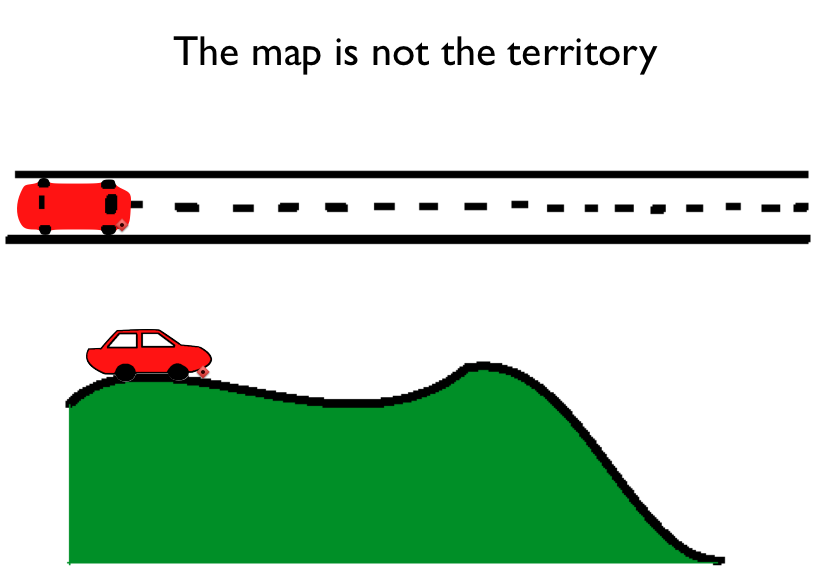
    A systems models is a kind of map of the system and it is important to remember that "A map is not the territory".


    Monday, June 20, 2016

    Schooling - symptoms and causes


    Creating a linear view

    When faced with something challenging and complex, our natural inclination is to treat it as if it was linear. And under certain conditions this can be useful. The danger is that we may begin to confuse our "linear models" reality. 

    Schooling is a complex endeavour - one that is often complicated and uncertain, especially in relation to the processes, participants and the contexts in which it occurs.

     Consider the following simple linear model of schooling:

    The model is a reasonable summary of the commonly held view of how the school system works. Because of its general nature the model "works" despite the variations that that may apply. For example, government policy and funding varies considerably from school to school and government to government.

    Cause and effect
    In terms of time and activity the general flow of cause and effect is from left to right. Since most students are children they tend to have little or no responsibility for the effectiveness of the system. This "justifies" the widespread use of of student achievement (effect = learning outcomes) as an measure of school performance as cause.
    Also cause and effect can be remote in both time and place - a cause may not be directly related to a effect (see 5 Whys). For example, the model does not indicate the extent to which government policies and funding enable/constrain the capacity of schools to provide teaching matched to the needs of their students in real-time.

    Too simplistic
    The model is too simplistic in that it does not show any feedback loops nor does it give any indication of strength of flows between its elements. 

    Nor does the model show all key participants many of which play an important role in the effectiveness or otherwise of the system.

    A useful starting point
    The model is quite inadequate to properly explain how schooling happen. On the other hand it does represent the general discourse quite well and hence could be provide a useful starting point for the development of a systems approach to school improvement. And a systems approach is needed to better inform decision making at all levels.
    Caveat:  "All models are wrong but some are useful (George Box)"

    Monday, May 23, 2016

    Gonski and beyond

    Gonski may have a more important modelling role to play in improving the education of all Australian students. Extending the Gonski approach to all schooling could save our schools from current well intentioned but poor top-down decision making.

    Money is vital, but methods translates money into value. And the Gonski "method" is soundly based for education.

    The current general discourse about schools goes something like
      
    More $ for Education
          -->  "Better" teachers, testing/reporting, required curriculum, mandated practices....
             -->  Better student Outcomes

    This is plausible from a management or production perspective, but it does not reflect any known education theory.

    Schools are not factories!! Education is not a form of production. Students are not products.

    In addition this common top-down approach does not result in the requisite variety of educational provision needed to meet the needs of all students. 

    The value of Gonski

    In contrast, Gonski encourages and supports the development of whatever provision will meet the needs of specific students.

    Some useful theory

    Education is a complex endeavour. Schools are best understood as complex adaptive systemsTo work with and improve complex adaptive systems we need appropriate theory. 
    • People in schools (and elsewhere) are self organising around what attracts their attention
    • Schools are situated and emerge from the interactions of those involved - students, staff, families, communities, departments, governments...
    • Schools co-evolve with their environments (communities, school system....)
    • Successful practices are not as readily transferable as one might assume - they have to be reconstructed 
    The necessary knowledge, actions, and arrangements involved in schools have to be continually constructed (and re-constructed) by those involved, mostly in everyday conversations. Practices from elsewhere have to be reconstructed anew in each school.

    This means that schools not subject to empirical research in an engineering sense.
    • Input --> Process --> Output is not a useful working model for whole school improvement
    A constructivist perspective (Vygotsky)
    • Zone of proximal development
      • Learning expands/extends what a person can know and do
      • At any point in time there is a potential "zone" of learning beyond what person can know and do with "assistance"
      • This developmental zone is specific to each person in place and time
      • At any point in time, it is not feasible for a person to learn beyond their zone of proximal development
    • Scaffolding
      • Provision to support learning ("scaffolding") needs to be matched to the learner's zone of proximal development in place and time (Gonski)
      • Teaching is largely about scaffolding learning
      • Better scaffolding is likley to improve and extend learning
      • Scaffolding can be
        • Cognitive - instruction, direction, coaching and tuition...
        • Physical - texts, tools and equipment, facilities...
        • Chronological - timing, sequencing...
        • Social and emotional - encouragement, motivation, confidence...


    Leadership is situational (Blanchard)
    1. Education involves substantial leadership
    2. Leadership is a combination of direction, coaching, support and delegation 
    3. The appropriate leadership style depends on the learner's Competence and Confidence / Motivation in  relation to the learning task to be addressed in the current context

    Gonski - a model for the future of schools

    Gonski (consciously or otherwise) is consistent with a constructivist approach​ and encourages situated leadership. The initiatives supported by Gonski are situated and emergent.

    If the Gonski approach can be extended to all schooling, it will improve learning outcomes of all students and reduce the need for Gonski as an add-on.

    Caveat: For this extension to occur it will be necessary for governments and senior bureaucrats to recognise that 
    • While they may be in charge they are not in control
    • Education is a complex endeavour
    • Engineering solutions do not apply to the key challenges involved in providing quality schooling for all

    Tuesday, January 6, 2015

    People are self-organising

    If you look at the world's leading, most effective, most resilient "organisations" (Google, Apple, MSF...), one of the things they have in common is that they enable their people (both staff and clients) to be self organising.

    Their organisational structures, policies, processes enable the people involved to be self-organising around significant goals ("attractors").

    The opportunity to be self-organising is a fundamental human need. Many societies punish offenders by reducing their capacity to be self-organising - offenders are put in gaol, denied the right to drive, fined, grounded, lose their mobile phone for a week... When people are constrained from being self organising in one area they tend to find new ways to meet this need.

    Some of the quickest, cheapest ways to improve any organisation (and do more with less):
    • Make the goals more attractive to those involved and
    • Expand the opportunities for collaboration (negotiated self-organisation)
    This works because it takes less effort to do "what we want to do" than "what we have to do".

    Unfortunately many of the dominant management ideas that counter the above
    • We need managed organisations because people can't/won't organise themselves (why not?)
    • We need to safeguard against people making ill-informed choices (but remote managers continually assume they make better choices?)
    • Leaders need to be in control (but in reality, they are only in charge at best)
    • Compliance is more important than contributing (but people need to contribute)
    The above ideas are not new: “A leader is best when people barely know he exists, when his work is done, his aim fulfilled, they will say: we did it ourselves.” (Lao Tzu 600 - 531 BC)

    Sunday, February 9, 2014

    Restorative practices - an intelligent approach

    We act intelligently when we improve/increase our future options and address the bottlenecks (constraints) that we encounter along the way. On this basis, restorative approaches are likely to be more intelligent than the common punitive approaches used in many schools. 

    Suspensions, expulsions, zero-tolerance... may reduce local difficulties in the short term but they rarely represent an intelligent response - problems are not really resolved and are likely to recur and to be extended albeit to other places and other times. 

    Quite often, the natural consequences of a punitive approach far exceed the formal consequences imposed by the punitive system: suspensions become pushouts become an uncompleted education, long term unemployment, poverty... and so on.  Yet schools are supposed to be places that nurture intelligence.

    Punitive approaches tend take away options from wrong-doers (and from those who have to respond) by placing ongoing constraints on their current and future options. A suspended or expelled student may have few genuine opportunities to learn from their own actions, and to repair the harm they have done. 

    Punitive policies, such as "three strikes and you are out...", also reduce the capacity of school staff to explore options that will result in a better future for all. That is, such policies even reduce the capacity of staff to act intelligently. 

    Using punitive approaches the initial harm is rarely repaired and on-going costs are likely to increase. Victims may acquire long lasting bottlenecks (e.g, anxiety...) that are very costly, greatly extend the initial unresolved harm and reduce future options.  Without help to repair the harm they have experienced, a seriously bullied student may become a school-refuser and/or do harm to themselves and/or others, all of which reduce the student's future options and life chances. For more, see Compass of Shame.

    Using a restorative approach, a wrong-doer is challenged and supported (Social Discipline Window) to 
    • gain insights into what happened and the thinking involved
    • gain insights into the harm that has been done, and to whom
    • take steps to repair the harm that has been done (if at all possible) and
    • remain in school as a civil and productive student within the school and its community
    Clearly, using this approach, the 'offender' has a brighter future (more options and fewer bottlenecks) despite the seriousness of their initial actions.

    And a student whose harm has been properly addressed in a restorative way is less likely to experience the shame of being a victim and is thus more likely to have an unimpaired future.

    Of the two approaches, being restorative is clearly much more intelligent than being punitive.

    [Note: The above thoughts were prompted by the TED Talk by  Alex Wissner-Gross: A new equation for intelligence. The talk may not be all that easy to follow at times.  However, its value was that it reminded me about the signs of intelligence]

    Sunday, January 12, 2014

    Don't dismiss the nay-sayers

    The US Department of Education has just released new guidelines that will reduce the use of zero tolerance and punitive approaches to school discipline, especially suspensions and expulsions. The new guidelines promote wide-spread use of restorative practices. 
    Great news for many students and for the RP movement?  Maybe. Maybe not! The challenges involved  in scaling up the use of RP will be very significant. And there are a number of voices expressing serious concerns about the move to what they see as soft or weak approaches to poor student behaviour. For example,  consider the views expressed here: news.investors.com/ibd-editorials… 
    Such perspectives need thoughtful consideration by all RP advocates. It would be a mistake to simply dismiss such perspectives as being ill informed about restorative practices, which I believe they are. Restorative practices do not require teachers to 'tolerate poor behaviour' - quite the opposite!!
    But... the skeptics and critics could well be right about the likely outcomes in situations where implementation of the guidelines is simplistic, naive, incomplete and/or poorly managed. 
    Restorative practices are not 'silver bullets'. They are much more than a set of techniques to fix problems. To be effective they need a context that includes shared values and purposes, an engaged and supporting community, and real moment-by-moment relationships that are deeply valued by all concerned. 
    Implementing the new guidelines will not be effective if seen as a simple administrative change to the way in which schools respond to problematic incidents. At the same time, implementation will involve major administrative changes to the way many schools manage problematic student behaviour.
    Proper implementation of the new guidelines will require the achievement of sustainable whole school change and will take a number of years. Consider this very useful overview from SaferSanerSchools.orghttp://t.co/U1xPTDIiWt
    Anything less could well be more harmful than helpful. Poor implementations could harm the credibility of restorative practices and hence restrict its potential to help improve our schools in particular and our society in general.
    The new guidelines will bring new challenges for the skilled and experienced restorative practitioners on whose achievements the new guidelines are based. 
    Please don't dismiss the nay-sayers - we have much to learn from each other. 

    Friday, November 29, 2013

    Responding to problems

    Things go wrong from time to time. People sometimes 'do the wrong thing' - sometimes by choice, other times by error or accident. In every case there can be value in making multilevel responses to the problem at hand.

    1. Contain the problem to minimise further harm. 
    2. Repair the situation (working with the parties involved if possible)
    3. Learn how the problem occurred (focus on process before people)
    4. Prevent (or reduce the likelihood of) the problem recurring

    There is a tendency to blame the person who 'caused the problem' and/or to change the system.  Improve the system/process only if necessary. Often nothing needs to be changed. Blame is usually unproductive -  the person who 'caused the problem' often simply lacked some key insight, understanding, knowledge or skill. Work with them to bring them up to speed.

    And, try to avoid the use of counter-measures such a increased control and supervision, extra requirements, needing permission, new restrictions... Counter measures are often costly to implement and difficult to maintain. 

    Restorative practices are a good example of a multilevel response when someone has 'done the wrong thing'.

    Thursday, October 31, 2013

    The school system - enabler or driver?

    For more than a decade Tasmanian public education has been in a state of continuous structural and policy change. Given the disappointing outcomes this is likely to continue. Well intentioned  initiatives have been largely top-down, one-size-fits-all approaches that ultimately require the compliance of staff at all levels. That is, governments and senior officers have attempted to drive improvements from on high by providing schools and staff with the answers while failing to properly understand the questions - classic MBO (management by objectives, circa 1960s).

    To be fair, most initiatives have been rational, "best practice" and/or "evidence based" meaning that the initiatives appear reasonable and have been successful elsewhere. However, initiatives have to occur in a context and each situation (student, teacher, school, family, community...) involves a different context: each with its own history, needs, hopes, culture, resources...

    In engineering, "best practices" are readily transferable - cause and effect are consistent over place and time and the outcomes are predictable The same cannot be said for human endeavours such as education. Education is a complex endeavour, not subject to consistent natural laws. In complex systems similar initiatives can have very different outcomes in different places - like the weather, starting conditions (the initial context) make can a huge difference.

    Schools, classes, education departments... are all complex (adaptive) systems. They are not factories that can be controlled in a mechanical way - the processes involved are not based on natural laws.  They are not changed by flicking switches and turning dials. Rather they are the sum total of the everyday interactions of their various parts  (the people, policies, rules, working relationships, resources, opportunities... and the context).  What happens emerges over time from the all interactions of the parts of the system.

    Key questions
    What is the purpose of our systems?  
     - We create systems in order to achieve what is desirable.

    What are the underlying mechanisms involved?
    - In context, the people involved continually construct (and reconstruct) their knowledge, (inter)actions, arrangements and relationships in ways that will (ideally) help them achieve of what is desirable.

    What design principles might apply? 
    At all levels, systems should enable the achievement of their purposes easily and well.
    Systems should also incorporate their own ongoing improvement strategies.
    Due diligence should be undertaken before implementing a major proposal

    Implications
    The implications are that top-down initiatives need to be complemented by matching responses throughout the system. To be successful initiatives need to be coherent and useful. All this sounds a bit cumbersome, so why not allow people at the top make the decisions to drive the achievement of what is desirable?

    When systems try to drive detailed change they often end up requiring compliance and this is usually counter-productive and difficult to sustain. When  system requirements conflict with the immediate needs of students, schools and staff often face a dilemma. Such dilemmas are best understood as  opportunities for learning and for system improvement. If such a dilemma is resolved by requiring compliance there will be more losers than winners, especially in the longer term.

    The alternative is for the system to focus on providing enablers (purposes, principles, tools...) that will nurture the emergence of what is desirable. People want to do well and to contribute - schools and their staff care about the success and well-being of their students. The system needs to be judged by the extent to which it enables all to achieve success and well-being now and it the future.

    Wednesday, October 23, 2013

    Evaluating proposals - some useful questions

    All proposals are naturally about achieving a better future and are usually presented as "good ideas". Business regularly does due diligence before undertaking major projects. Unfortunately the same cannot be said for education. Before proceeding with any significant initiative it could be worth considering following

    Sample Questions
    1. What differences will we notice if this proposal is successful?
    2. What small scale evidence supports the proposal?
    3. What is necessary for the proposal to succeed?
    4. What is sufficient for the proposal to succeed?
    5. How does the proposal integrate with our key purposes, processes, the present culture, and other historical, current and future initiatives?
    6. Where is it already happening?
    7. What will be the costs of any failure?
    8. Will it be safe to fail
    9. What responses will be made to those situations where the proposal does not work
    10. Can the proposal be easily reversed or abandoned at any stage? 
    11. What is the expected cost of implementing the proposal? (Costs mat include include losses and waste in terms of finance, time, energy, expertise, disruption, deterioration, resources, expertise, social capital,….)
    12. Will the outcomes be sustainable ? Will they require substantial ongoing support and maintenance?
    13. Are we ready, at this time, to undertake this proposal?
    14. Is there a better, cheaper, less disruptive and safer way to achieve the same outcomes?
    Three Key Questions
    Working through the above (or similar questions) collaboratively will enable consensus to be reached on three key questions:
    1. Is it desirable (and for whom)?
    2. Is it possible (and by what method)?
    3. Is it feasible (and in what time frame)?